

A Leader’s Guide to Managing Change Fatigue
The problem is not really the change itself. The problem is the delivery, volume and frequency of it.

Hello friends,
At the end of a leadership course I attended last year, a man I deeply respect delivered a talk on leadership during periods of constant change. One thing he said stayed with me:
“Lead from the front.”
Not in a dramatic sense, but in the sense that a leader’s visibility can create calm when everything around people feels unstable.
Over the last year, I’ve thought a lot about that conversation and the effect constant change has on people, especially at work.
Today’s post is about something very real, but often overlooked:
Change fatigue.
Growing up, I had friends whose parents moved around frequently because of work. By the fourth school, some of them had mentally checked out. They were tired of constantly starting over.
I’ve seen the workplace equivalent too.
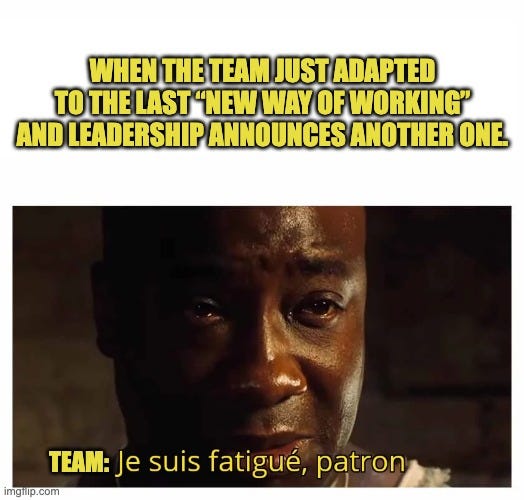
A team finally adapts to one process, then another change programme arrives. They get used to one system, then leadership introduces another one. One week it is “centralisation,” the next week it is “agility.”
At some point, people stop resisting change because they are stubborn. They resist because they are exhausted.
And yes, change fatigue is real.
To better understand change fatigue, we first need to understand what organisational change actually means.
What Organisational Change Really Means
Organisational change refers to significant shifts in how a business operates. That could mean changes to technology, leadership, structure, culture, or ways of working.
And to be fair, organisations usually have valid reasons for changing. Markets evolve. Regulations change. Businesses restructure. Digital transformation initiatives emerge. Suddenly, everybody must stop using paper because “the future is digital.”
The problem is not really the change itself.
The problem is the delivery, volume and frequency of it.
At some point, people become saturated. Their ability to absorb change weakens, and signs of fatigue begin to show.
What Change Fatigue Looks Like
Change fatigue does not always announce itself dramatically.
Sometimes it appears quietly.
People become less enthusiastic. Productivity drops. Energy disappears from meetings. The same team that once embraced improvement suddenly responds with sarcasm, frustration, or silence.
You may notice:
increased absenteeism
low morale
stress and irritability
resistance to new initiatives
pessimism toward leadership
declining engagement
What Leaders Should Do
The truth is, organisations should plan change properly in the first place. Not every transformation initiative needs to happen at the same time. Good sequencing matters. People need enough stability to absorb one major change before another arrives.
But once change fatigue has already set in, leadership behaviour becomes critical.
Here are three things that matter most.
1. Be Visible
When uncertainty increases, people naturally look toward leadership for stability.
This is not the time to disappear into closed meetings and unread emails.
Be present. Answer questions. Walk the floor. Acknowledge frustrations honestly.
Your visibility communicates something important:
“We are going through this together.”
Your visibility reassures people that leadership understands what the team is experiencing and has not abandoned them in the middle of the change.
2. Communicate Early and Clearly
One mistake many leaders make is waiting until people ask questions before communicating.
By then, assumptions have already started spreading.
People do not need every single detail immediately, but they do need clarity around what is changing, why it matters, what the timeline looks like, and how it may affect them.
Most importantly, communication should not be one-directional.
Create room for feedback.
People do not want to feel that change is being done to them rather than being done with them.
3. Build Confidence Through Knowledge
A lot of resistance to change is actually fear disguised as resistance.
People worry they will not understand the new system, adapt quickly enough, or perform well in the new environment.
Imagine introducing a digital rostering system to a team where some staff still print emails because “it feels safer on paper.”
You cannot simply announce the change and disappear.
Training matters. Support matters. Repetition matters.
The more capable people feel, the less threatening change becomes.
Confidence reduces resistance.
Wrapping Up
Change is unavoidable.
But unmanaged change fatigue is not.
People can adapt to difficult situations remarkably well when leadership provides clarity, stability, support, and direction.
And sometimes, the most important thing a leader can do during change is not to have all the answers.
Sometimes it is simply to remain visible enough that people do not feel abandoned while navigating uncertainty.
Until next time,
Tomiwa Femi-Philips
Strategic Transformation | Improvement
The Lean Leverage Hub