

Why Leadership Accountability Is Important in Change Management
If everyone is accountable, then nobody really is.

Hey friends,
Before we jump in, let’s clear something up:
Accountability in leadership isn’t about blame.
Too often, when we talk about “holding leaders accountable,” people hear “finding someone to fault.”
That’s not it. In fact, far from it.
Today, let’s unpack what accountability truly means in improvement work, why it matters, what it looks like in action, and what happens when it’s missing.
Let’s dive in.
Accountability ≠ Blame
When a leader is accountable for a change or improvement initiative, it does not mean they’re being singled out, punished or set up to fail. It simply means they own the direction and the outcome of the initiative (good or bad) and must be ready to fix it if it doesn’t go as planned. That’s it!
Blame, on the other hand, is very different.
Blame is about pointing fingers and asking, “Who caused this?”
Leadership accountability is about ownership of the outcomes and asking, “What’s the right next step?”
Accountability ≠ Responsibility
These two sound similar, but they behave very differently.
Responsibility is the work, the tasks, activities and actions.
Accountability is the outcome, the result. Did the change happen?, Did it stick? Did it deliver value?
It’s okay for different people to be responsible for different bits of an improvement initiative, but accountability should sit with one person.
When everyone is “accountable,” it means no one is actually accountable.
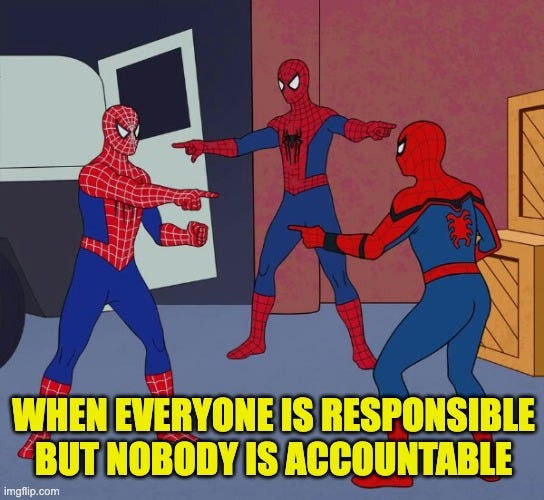
What Happens When a Project Has Responsibility but No Accountability
When leadership accountability is missing, three common things happen:
a. Everyone is busy, but progress is shaky.
Teams are working hard on the tasks they’re responsible for. Updates are flying up and down. There are dashboards, trackers, meetings, and RAG-rated risks, but because no senior leader owns the outcome, the work is not really aligned to anything firm. No one is asking the senior leader why the target has not been met this month and how they intend to meet the target next month.
b. Escalations get messy
This isn’t about not knowing “who does what” as responsibilities are usually clear enough. The real confusion is who makes a decision when there’s a problem or a blockage.
When things get stuck:
“Let’s raise it at the next meeting.”
“Let’s discuss it again.”
By the time the decision comes, momentum has gone cold.
c. The change doesn’t stick
This is the most painful part.
If nobody owns the outcome, sustainability disappears.
Teams quietly go back to old habits, not out of stubbornness, but because nothing was anchoring them to the new way of working.
Two Levels of Accountability Every Organisation Needs
For change to work well, accountability has to show up in two places:
a. Structural Accountability
This is the organisational side:
It’s the system that makes it clear how decisions are made, who owns the overall direction of the project, and how progress will be monitored.
When a project has strong structural accountability, people know where issues should go, who has the authority to unblock them, and what success should look like.
Without this structure, even a hardworking team ends up confused because the project is being steered without a steering wheel.
b. Personal Accountability
This is the human side:
It’s about leaders and teams following through on what they’ve committed to.
A leader who is personally accountable shows up consistently, asks the right questions, removes barriers, and stays engaged from start to finish.
Teams also play their part by raising issues early, providing honest feedback, and owning their contributions.
When the structure is strong but people don’t follow through, the project stalls.
When people are committed but the structure is weak, the project becomes chaotic.
The best results come when both sides work together: a clear structure, backed by leaders who take ownership of the outcome.
So What?
If you want change to last and not just look good on a slide, accountability has to sit at the top. Not the kind that hunts for who to blame, but the kind that provides direction, holds the vision steady, and stays committed until the work is done.
Responsibility gets tasks done, accountability turns activity into progress, but leadership accountability? That’s what produces real results.
When leaders are accountable, it inspires others to behave similarly. And in a world where change is the only constant, it’s key to getting successful outcomes.
Tomiwa Femi-Philips
Continuous Improvement Expert
Like this one !